AI-Based Note-Takers Are a Security Time Bomb
AI notetakers turn private meetings into a searchable intelligence layer. The real risk isn’t one leaked transcript; it’s what an LLM can infer across the whole corpus. A security playbook.
AI notetakers are on the rise.They turn your private conversationsinto a searchable intelligence layerbut they add risk beyond one leaked transcript.Imagine an LLM that can infer across the whole corpus.

AI-based note-takers transform private meetings into an information layer that enables organizational efficiency. But when provided by young companies that don’t always know how to protect data, or sometimes aren’t committed to protecting it themselves, these tools open the door to AI-driven risks that could be devastating.
Artificial intelligence gives us the power to process amounts of data we never could before. It’s not just a matter of “efficiency” or intelligence. It's also a scale that was previously unattainable. Unfortunately, these scaling capabilities create another cyber threat that weakens the SaaS offering.
AI-based note-takers don't just record meetings. They turn a company's private conversations into a structured intelligence layer that can be searched and analyzed.
At TensorOps, I use this to create a database that helps me identify stuck processes, give managers summaries of what's happening in meetings under their purview, and, of course, for the standard uses of meeting summaries and reminders.
But the ability to analyze this data at scale raises tough questions about the danger if a malicious actor acquires the information and begins processing it. In the past, even if an attacker obtained all the transcripts, they would have to sift through thousands or millions of sentences to understand what was going on. With Transformer technology, this is no longer the case.
This danger raises a difficult question regarding the viability of using SaaS call recorders. Are you certain that a small company, despite having SOC2 and GDPR compliance, will actually do a good job protecting your data? And if that company runs into financial trouble and your competitor offers to buy all your trade secrets for $250,000, might they sell?
In this article, I will describe why I believe AI poses a real danger to these tools, tools born from the very AI revolution that might now turn against them.
A History of Leaks
Even without a massive data breach, an incident at an Ontario hospital already involved an unapproved Otter.ai transcription tool joining a virtual liver ward rounds meeting via a former doctor's calendar. The tool recorded a meeting discussing patient information, and then sent a transcript and summary to a broad guest list that included former employees.
This is a severe privacy violation. However, the core issue wasn't that an LLM suddenly created a new risk category. It was weak control over calendars, approved tools, participant lists, and recording permissions. Even a non-AI recording tool could have caused the same exposure.
The real risk begins with our decision to essentially digitize every piece of information. Therefore, the starting point must obviously be defining the correct scope. You must consider in advance whether it is appropriate to record a sensitive conversation about employees or a private chat during working hours.
But that specific security issue isn't unique to AI. What AI does do is allow for the simultaneous analysis of thousands or millions of conversations. It can find patterns no human reviewer would have the time to find, connect remarks made by different people in separate meetings over months, and deduce priorities, vulnerabilities, customer sentiment, negotiating positions, financial pressures, and strategic directions.
Before LLMs, a leaked recording archive was dangerous but expensive to exploit. To gain insights someone had to listen, categorize, and summarize. When the volume of information was large enough, it required either deploying many people or using analytical tools, and even then, things would simply get lost. With LLMs, not only does the marginal cost of analysis collapse, but an opportunity arises to simultaneously analyze various generated contents. This is why AI note-takers are a security time bomb.
Why Does AI Change the Risk Model for Meeting Data?
For years, companies thought data storage was a question of “where the bits sit.” Regulations like sub-processing rules, which required companies to disclose what tools were used to process data, were largely ignored or treated as “I don’t really know what to do with it but, just give me a certificate saying you’re ok”. More sophisticated companies did look into it and indeed blocked applications for example that run subprocessors that are sensitive to their business.
And yet, for most companies the phrase “data leak” makes them think of files: a spreadsheet, a recording, a transcript, a folder being exposed and someone obtaining access to a specific set of sensitive documents. The main risk would be that an attacker would find API keys that could hijack the storage or some sensitive client information that will be used for blackmail. But could someone deeply understand your business from the leaked information?
Furthermore, I’ve seen how over the years, various companies (not necessarily note-takers) have unilaterally announced, “From now on, we are analyzing your data using AI tools and even using it for training.” Do a Google search and you’ll find many examples of how suddenly, hidden behind 25 screens and options, there’s a checkbox checked by default saying you allow your data to be used for model training. What does this mean? If this happens in the case of note-takers, all your trade secrets become another company’s asset.
What is the Safer Alternative to SaaS AI Note-Takers?
In my view, the answer is not to ban the use of AI note-takers. They are useful, and companies will continue to use them. The answer is to change the architecture: AI note-taking should be company-owned infrastructure, not a generic SaaS subscription that quietly hoovers up its most sensitive conversations.
A safer model relies on three principles: meeting data stays in the customer's environment; the vendor retains no raw audio, transcripts, summaries, embeddings, or extracted insights unless explicitly opted in by the customer; and customers can self-host transcription and summarization models when data sensitivity demands it.
The vendor provides the software. You own the data. What a safer architecture looks like:
- Data stays in place: Audio and transcripts never leave your cloud. Capture infrastructure like Recall.ai can stream meeting data directly into your environment with zero retention where supported.
- Nothing is retained: No raw audio, transcript, summary, embedding, or derived insight is stored with the vendor unless you choose so. A managed deployment of TensorOps runs within your cloud and retains none of your meeting data.
- Models can be self-hosted: For the most sensitive conversations, run transcription and summarization where the data already lives, so the collection of recordings never has to move at all.
This is the right direction for sensitive enterprise AI. The vendor can provide the software. The customer must own the data.
Recorder Architecture over AWS
To implement this secure infrastructure, I look toward a robust cloud architecture built over AWS.
The shape is two tiers. A lightweight control plane exposes the API, schedules and dispatches the recording bots, and runs the autoscaling logic. Behind it sits an autoscaling fleet of worker nodes that does the heavy lifting: every meeting is handled by its own short-lived container that joins the call, captures audio and video, and tears itself down the moment the meeting ends, so nothing about one meeting outlives it.
Architectural Principles & Solution:
- Authentication: The user joins the meeting from their laptop, securely authenticated as an authorized user via the organization's SSO/Identity Provider.
- High-Bandwidth Capture via EKS: A containerized recording application, orchestrated by Amazon EKS (Elastic Kubernetes Service), acts as a bot that joins platforms like Google Meet or Zoom. EKS is leveraged here specifically to handle the high bandwidth and dynamic scaling required for real-time video and audio streaming.
- VPC Isolation: The captured audio and video streams are routed directly into the organization's Virtual Private Cloud (VPC).
- Zero Retention & Processing: Data is processed in-memory or held in an encrypted, ephemeral state within the VPC just long enough to generate the transcript. It never touches external servers, ensuring complete data sovereignty.
Because meeting load is bursty, the fleet scales with demand: a small always-on baseline covers steady traffic while burst capacity spins up on low-cost spot instances when many calls start at once, then drains away again. It handles many concurrent meetings across Google Meet, Zoom, and Microsoft Teams, and scales to zero outside working hours to keep the bill flat. Recordings and transcripts are written straight to object storage in your own account; only lightweight metadata lives in a managed database. Transcription is pluggable: a managed API when convenience wins, or a self-hosted open-source model when the data is too sensitive to leave your environment.
Using Large Language Models
Large Language Models (LLMs) are perhaps the bottleneck of this story.
Using the best models can make the solution more expensive and also expose me to the original problem, since the top-tier models are only accessible through proprietary companies like ElevenLabs and OpenAI.
The best models I found for the task so far were OpenAI’s 4o Transcribe and ElevenLabs’ models. However, the landscape of speech-to-text models is evolving rapidly, as can be seen in Hugging Face’s Open ASR Leaderboard, which keeps updating.
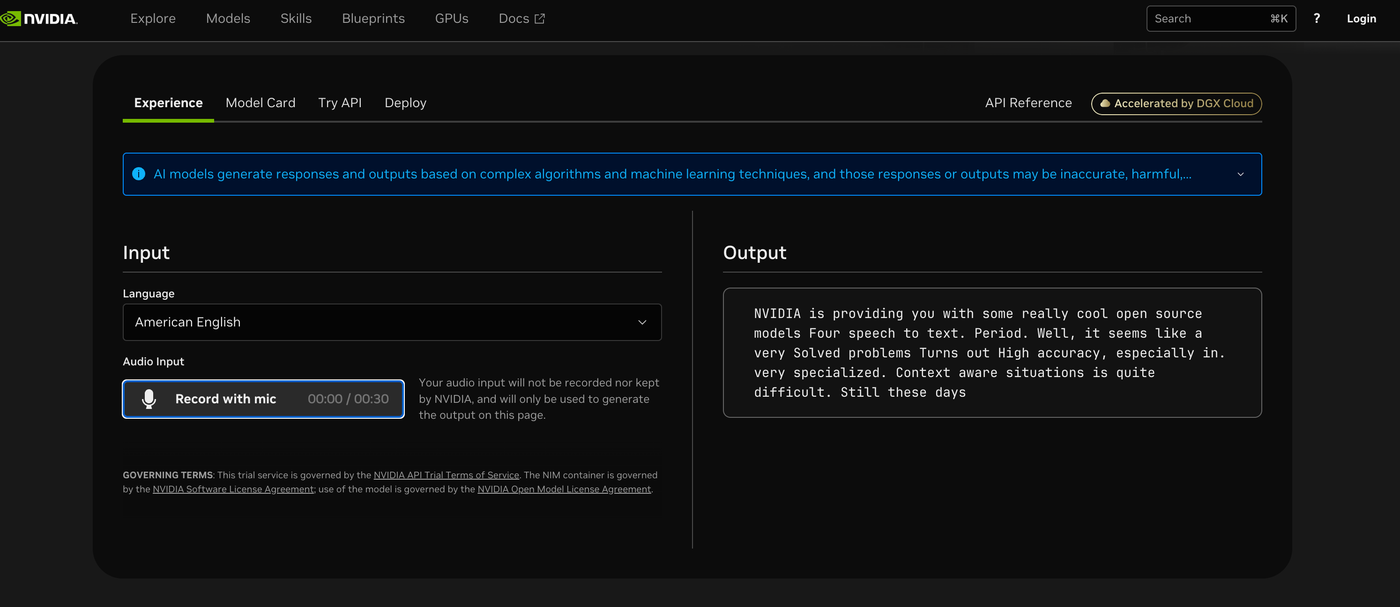
I believe that as time goes by these models will keep improving, and my responsibility will be to tune the transcription to be domain-specific. For now, I fix some of the typos by introducing term correction during the batch phase.
Final Remarks
The AI revolution is not just about efficiency and agents; it is also about the perception of data, how data can be used effectively in your business, and what its value is. I believe AI note-takers are a wonderful example of the real value of data. Your sales calls with clients, your organizational knowledge base, and more capture the essence of how you run your business. On one hand, you can benefit enormously from it: as a manager you can understand bottlenecks in sales calls, catch violations, and get a snapshot of what is happening inside your organization. But you are also creating a vulnerable asset, one you need to protect well.